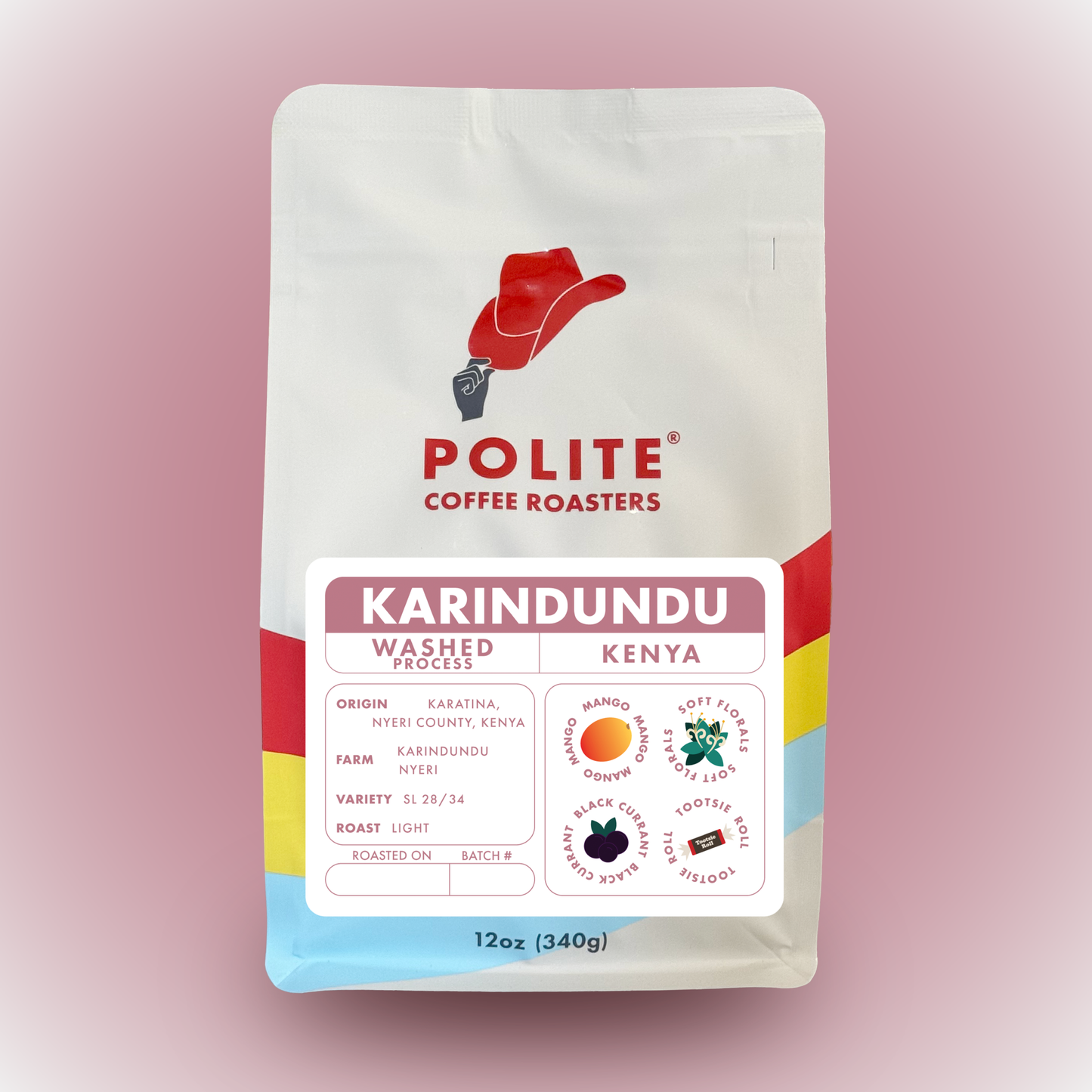


KARINDUNDU | KENYA *LOW STOCK*
KARINDUNDU | KENYA *LOW STOCK*
Couldn't load pickup availability
The Karindundu factory is located in the lowland region of Mt. Kenya, 1 km from the town of Karatina in Kenya’s Nyeri district. There are a total of 513 active members (349 male, 164 female) contributing to annual production, each with an average of 300 trees and 0.5 acres. Farmers grow macadamia, banana, maize, and beans near their coffee. The factory sits within the fertile slopes of Mount Kenya—a region widely regarded as one of the country’s most important coffee-growing areas.
Farms supplying Karindundu are positioned between 1,700 and 1,900 meters above sea level, where cooler temperatures slow cherry maturation and promote the development of dense, high-quality beans. The region’s deep red volcanic soils, combined with reliable rainfall and a stable climate, create ideal growing conditions that translate directly into cup quality. These environmental factors are key to the bright structure, clarity, and layered sweetness that buyers look for in Kenyan coffees.
Karindundu operates under the Barichu Cooperative Society, a well-established cooperative known for its commitment to both quality and producer support. For importers, this structure offers a level of traceability and consistency that is critical when sourcing repeatable lots. The cooperative aggregates coffee from smallholder farmers—most managing small plots—and ensures that processing and quality standards are maintained at the factory level.
Farmers are paid competitive prices for their cherry, especially for higher-grade selections, which incentivizes careful harvesting and delivery practices. In addition, the cooperative provides ongoing training in agronomy, selective picking, and farm management. These initiatives directly impact cup quality while also supporting long-term sustainability at origin.
Environmental practices are also an important part of the picture. The cooperative encourages the use of organic inputs where possible and promotes responsible waste management, including the recycling of coffee by-products. This aligns with the expectations of many roasters and consumers who are increasingly focused on sustainability within the supply chain.
Equally important is the cooperative’s focus on social impact. Barichu has made efforts to support gender equity within its membership, creating opportunities for female farmers to participate more actively in both production and decision-making. From an importing standpoint, these initiatives contribute to a more resilient and stable producer base—something that ultimately benefits the entire supply chain.
Coffees from Karindundu are valued not only for their quality but also for their reliability. The combination of strong cooperative management, ideal growing conditions, and consistent processing standards allows us to offer lots that perform well year after year.
The coffee is composed of a blend of well-known Kenyan varieties, including SL28, SL34, Ruiru 11,
SL28, originally selected in the 1930s, is especially valued for its drought tolerance and complex, sweet profile with wine-like undertones. SL34, another historic selection, is admired for its rich body and balanced acidity, though it requires careful management due to its susceptibility to disease.
Ruiru 11 offers high yields and strong disease resistance, while Batian combines resilience with improved cup quality, making it an increasingly popular choice among Kenyan farmers.
Share